


Part of our Maths Functions in Excel guide
Excel ODD Function
The ODD function is a built-in function in Excel. As the name suggests, it rounds any given number to its odd value. The number can be negative or positive. So, for example, if the given input is =ODD(-1.5), the rounded result will be -3, and if the given input is =ODD(1.5), the result is 3.
- The function considers only numbers as input. We will get the “#VALUE!” error if the input is non-numeric or even alphanumeric.
- If the cell value is blank or empty, by default, the output is 1.
- We get the “#NAME?” error when the function’s name or formula is incorrectly entered, or if the cell value is non-numeric, without double-quotes.
Syntax
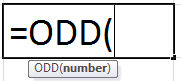
The ODD formula has only one critical parameter: number.
Compulsory Parameter:
- number: A numeric value that will be rounded to the nearest odd integer.
How to use the ODD Function in Excel?
Example #1
In this example, let us consider a set of positive integers 40, 18, 10, 26, 19, 20, 14, 17, 30, and 27 to understand the working of the ODD function. Now, apply the ODD formula in the cell, as shown in the below table. This function will round up all values to the nearest odd numbers like 41, 19, 11, 27, 19, 21, 15, 17, 31, and 27.
Things to Remember
- The ODD Excel function may return the # VALUE! Error if the supplied number is a non-numeric value.
- Irrespective of the value (+ve and –ve) of the number, a value is rounded up and adjusted away from zero.
- If the number is an odd integer, no rounding occurs.
Recommended Articles
This article is a guide to Excel ODD Function. We discuss the ODD function and how to use it, along with an Excel example and downloadable templates. You may also look at these useful functions in Excel: –